
The Allure of the Red City
Stepping into Marrakech is an immediate assault on the senses, a vibrant plunge into a world where ancient history effortlessly collides with modern luxury. Known affectionately across the globe as the “Red City” due to the warm, sun-baked ochre pigments of its clay walls, this historic metropolis stands as the beating cultural heart of Morocco. Nestled dramatically at the very foothills of the snow-capped High Atlas Mountains, it serves as an exotic gateway where African traditions, Islamic architectural mastery, and Mediterranean influences intertwine.
For the international traveler, finding the best things to do in Marrakech requires peeling back layers of centuries-old history. The urban landscape is a brilliant study in contrasts. On one side sits the historic Medina, an unyielding, thousand-year-old labyrinth protected by fortified ramparts. On the other side lies Gueliz, a modern, cosmopolitan district defined by wide, French-colonial boulevards, chic boutiques, and contemporary art galleries. Whether you are navigating the chaotic depths of the bustling markets, unwinding inside a tranquil tiled courtyard, or setting out toward the nearby Agafay Desert, this city offers an endless array of unforgettable experiences.
Exploring the Historic Heart – The Medina and Jemaa el-Fnaa
1. Witness the Theatrical Magic of Jemaa el-Fnaa
No exploration of the city can truly begin anywhere else than Jemaa el-Fnaa, the colossal main square that serves as the undisputed psychological epicenter of the Medina. For over a millennium, this vast open-air stage has drawn travelers, traders, and performers from across North Africa. By day, the square is a wide, sun-drenched expanse dotted with fresh orange juice stalls, traditional water sellers in elaborate red costumes, and spice vendors.
However, the true spectacle occurs as the sun begins to set over the minaret of the nearby Koutoubia Mosque. As twilight descends, a thick plume of aromatic smoke rises from dozens of numbered food stalls setting up charcoal grills. The square transforms into a massive, open-air theater. Intricate circles of spectators form around master storytellers (hikayat), hypnotic Gnawa musicians, acrobats, and local drummers. It is a raw, intoxicating manifestation of living Moroccan oral tradition, recognized by UNESCO as a Masterpiece of the Oral and Intangible Heritage of Humanity.
2. Seek Out a Panoramic View from a Rooftop Café
Navigating the crowds of the square at ground level can be overwhelming for first-time visitors. One of the best things to do in Marrakech to absorb the energy of Jemaa el-Fnaa without the chaos is to retreat to one of the multi-level rooftop cafes lining the perimeter. Iconic spots like Le Grand Balcon du Café de la Poste or Café de France offer front-row seats to the greatest show on earth. Ordering a glass of hot, heavily sweetened Moroccan mint tea—poured from a height to create a delicate layer of foam—and watching the thousands of shifting lights and crowds below is a mandatory rite of passage.
3. Get Lost in the Maze of the Souks
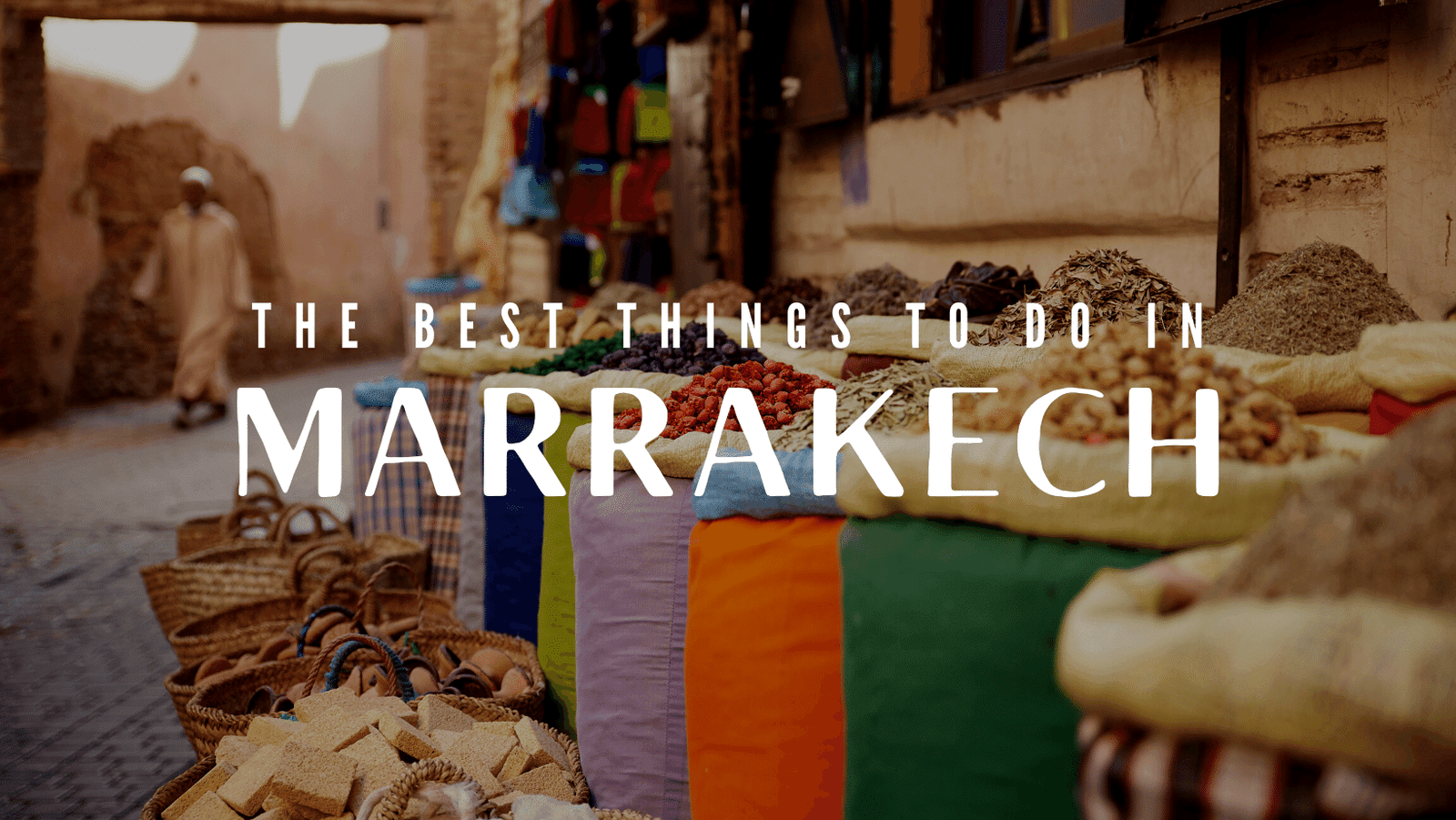
Branching directly off the main square lies a bewildering network of covered alleys known collectively as the Souks of Marrakech. This is the historic commercial engine of the city, where artisanal guilds have practiced their crafts for generations. The souks are roughly organized by trade, creating a sensory labyrinth where you can watch raw materials transform into exquisite goods right before your eyes.
Souk Cherifia: A more modernized, upscale market section featuring contemporary Moroccan designers, lightweight linen clothing, and high-end home decor.
Souk Smata: The brightly colored footwear market, lined from floor to ceiling with thousands of pairs of traditional leather slippers known as babouches.
Souk el-Kebir: The premier destination for fine leather craftsmanship, displaying hand-stitched bags, jackets, poufs, and travel luggage.
Souk des Teinturiers: The highly photogenic wool-dyers’ market, where great skeins of freshly dyed wool in vibrant shades of indigo, saffron, and crimson hang from wooden beams to dry in the sun.
Navigating this area requires throwing away your map and embracing the art of getting lost. Haggling (marachandage) is expected and deeply rooted in the local culture; it should always be approached as a polite, smiling negotiation rather than a confrontational battle.
The Architectural Triumphs of the Golden Empires
4. Marvel at the Scale of Bahia Palace
To experience the absolute peak of late 19th-century Moroccan luxury, a visit to the Bahia Palace is essential. Built by Si Moussa, the grand vizier of the sultan, and expanded by his son Ba Ahmed, the palace’s name translates literally to “The Palace of Brilliance.” The massive complex covers over eight hectares and was designed to capture the essence of Islamic and Moroccan architectural aesthetics.
As you wander through the labyrinth of rooms, look up to admire the breathtaking ceilings made of painted cedarwood, hand-carved stucco work, and elaborate geometric patterns. The crown jewel of the palace is the Great Courtyard, a vast open space paved in brilliant blue and yellow Zellij tiles, surrounded by elegant marble galleries. The palace rooms were deliberately designed with low doorways to ensure that anyone entering would bow their head in respect to the grand vizier, a subtle architectural nod to the absolute power wielded within these walls.
5. Step Back in Time at Ben Youssef Madrasa
For centuries, the Ben Youssef Madrasa stood as the largest Islamic college in North Africa, housing over 900 students within its walls. Founded during the Marinid dynasty and extensively rebuilt by the Saadians in the 16th century, this architectural masterpiece represents a profound spiritual and educational legacy.
The central courtyard is an awe-inspiring sight. At its center lies a shallow marble reflection pool, surrounded by soaring walls adorned with mind-bogglingly intricate geometric stone carvings, bands of calligraphic Arabic scripts, and thousands of hand-cut tiles. Walking up the narrow, dark staircases leads you to the tiny, austere student dormitories (hujras). Looking out from the small wooden windows down into the magnificent courtyard offers a powerful glimpse into the historical lives of the scholars who spent years memorizing the Quran in this sanctuary.
Ancient Ruins and Regal Dynasties
6. Discover the Hidden Splendor of the Saadian Tombs
For centuries, the spectacular Saadian Tombs remained entirely sealed away from the outside world, hidden behind a maze of high defensive walls in the Kasbah district. It was not until an aerial photography survey uncovered them in 1917 that these royal burial grounds were finally restored and opened to the public. This sacred site serves as the final resting place for approximately sixty members of the wealthy Saadian dynasty, who ruled over Morocco during its golden age in the late 16th and early 17th centuries.
The architectural centerpiece of the complex is the magnificent Chamber of the Twelve Pillars. Inside this mausoleum, the tombs of the sultan Ahmad al-Mansur and his immediate family are carved from pure Italian Carrara marble. The room features towering columns supporting breathtaking, vaulted ceilings of hand-carved cedarwood covered in pure gold leaf. The walls are wrapped in incredibly detailed, multi-colored geometric Zellij tiles. Outside in the quiet garden, tucked between rows of fragrant rosemary and palm trees, lie the simpler, tiled graves of loyal soldiers, advisors, and royal servants. It is a deeply peaceful place that showcases how the ancient rulers viewed death as an extension of royal luxury.
7. Evoke the Lost Opulence of El Badi Palace
A short walk through the old Jewish quarter, known as the Mellah, brings you to the haunting, colossal mud-brick ruins of El Badi Palace. Built by the Saadian sultan Ahmad al-Mansur to celebrate his historic victory over the Portuguese army in the Battle of the Three Kings, its name translates appropriately to “The Incomparable Palace.” Historical accounts suggest that during its peak, the palace was a dazzling display of wealth, featuring walls encrusted with turquoise, gold, onyx, and premium marble imported directly from Italy.
Today, the palace stands as a stark, majestic ruin after being systematically stripped of its treasures by a later ruler to build a new capital in Meknes. Despite its ruined state, the sheer scale of the complex remains utterly breathtaking. Visitors can wander through massive, sunken orange groves, explore dark underground prison cells, and climb the high earthen ramparts for sweeping views over the city roofs. Look closely at the top of the crumbling walls: dozens of massive storks have chosen these ancient ruins to build their giant, messy nests, creating a highly iconic and photogenic sight.
Modern Oases, Botanic Art, and High Fashion
8. Find Sanctuary in the Electric Blue Walls of Majorelle Garden
Stepping out of the historic center and into the modern neighborhood of Gueliz brings you to one of the most visited and iconic tourist destinations in all of North Africa: the Majorelle Garden. Originally created over a period of forty years by the French Orientalist painter Jacques Majorelle, this enchanting two-and-a-half-acre botanical garden is an artistic masterpiece.
The defining feature of the garden is the striking, intense shade of cobalt blue—now globally known as Majorelle Blue—painted across the villa, fountains, and planters. This bold primary color creates a jaw-dropping visual contrast against the lush, dusty-green foliage of the botanical collection. The paths wind past giant towering cacti, delicate water lilies, groves of swaying bamboo, and elegant trickling streams. In the 1980s, the property was purchased and saved from real estate developers by the legendary fashion icon Yves Saint Laurent and his partner Pierre Bergé. Today, a beautiful stone monument stands tucked away in the gardens to honor the late designer, whose creative soul was deeply inspired by the textures and colors of Marrakech.
9. Celebrate Haute Couture at the Yves Saint Laurent Museum
Located just a few steps away from the botanical gardens sits the ultra-modern Yves Saint Laurent Museum Marrakech (mYSLm). This stunning, contemporary building is a work of architectural art in its own right, featuring a facade constructed from local Moroccan bricks arranged to mimic the intricate warp and weft of woven fabric threads.
Inside, the climate-controlled permanent exhibition hall displays decades of the designer’s groundbreaking fashion creations, including iconic runway dresses, sketches, and accessories that revolutionized the global fashion industry. The museum beautifully highlights how deeply the local Moroccan culture, the vibrant markets, and the traditional garments worn in the streets of the Medina influenced Saint Laurent’s color palettes and fabric choices throughout his brilliant career.
10. Walk the Historic Paths of Le Jardin Secret
If you want to experience a traditional Islamic paradise garden without leaving the walls of the old city, Le Jardin Secret is an absolute hidden gem. Located inside an elegant, restored 19th-century palace complex in the Mouassine district, this peaceful sanctuary is an elegant escape from the intense energy of the surrounding markets.
The garden is divided into two distinct zones: an exotic garden filled with unique plant species from all over the world, and a traditional Islamic garden. The Islamic garden is laid out strictly according to the descriptions of paradise found in the Quran, featuring an ingenious layout divided into four precise quadrants fed by narrow, open water channels. This design represents the four rivers of paradise flowing with water, milk, wine, and honey. Sitting on a marble bench, listening to the soft sound of running water, and looking up at the elegant geometric architecture offers an incredibly calming experience right in the heart of the ancient city.
Spiritual Anchors and Regal Greenery
11. Admire the Architectural Silhouette of the Koutoubia Mosque
Standing proudly as the undisputed architectural anchor of the city’s skyline, the Koutoubia Mosque is the largest and most iconic house of worship in Marrakech. Built during the 12th century by the Almohad dynasty, this majestic structure represents the very pinnacle of Moorish-Islamic architecture. Its design was so profoundly influential that it served as the direct blueprint for other legendary global monuments, including the Giralda tower in Seville and the Hassan Tower in Rabat.
The defining feature of the mosque is its towering, 77-meter-high minaret, constructed from massive blocks of local rose-colored sandstone. The exterior walls are decorated with intricate geometric carvings, pointed arches, and bands of turquoise ceramic tiles. While non-Muslims are strictly prohibited from stepping inside the sacred prayer hall, wandering through the surrounding rose gardens, orange groves, and palm-lined plazas is one of the best things to do in Marrakech. At night, the entire structure is beautifully illuminated with warm spotlights, creating a breathtaking visual anchor visible from almost any rooftop terrace in the Medina.
12. Unwind in the Historic Olive Groves of the Menara Gardens
Located directly to the west of the city center, near the Marrakech Menara Airport, lies the sprawling, peaceful oasis of the Menara Gardens. Originally established in the 12th century by the Almohad rulers, this historic public park covers hundreds of hectares of land and features a massive, century-old olive grove containing thousands of irrigation-fed trees.
The crown jewel of the gardens is the large, central reflection pool, which holds millions of gallons of water transported from the nearby mountains via an ingenious, ancient underground canal system known as a qanat. Sitting prominently at the edge of the water is a highly photogenic, green-tiled pavilion (minzah) built during the 19th century as a royal summer retreat. On clear days, the still surface of the water acts as a giant mirror, reflecting a perfect image of the pavilion set against the jaw-dropping backdrop of the snow-capped High Atlas Mountains. It is a favorite weekend gathering spot for local families seeking a quiet escape from the urban rush.
Wellness Rituals and Culinary Masterclasses
13. Immerse Yourself in a Traditional Moroccan Hammam Experience
To truly understand the local lifestyle and unwind after days of walking through the dusty streets of the Medina, participating in a traditional Hammam is an absolute mandatory ritual. For generations, the public bathhouse has served as a central pillar of Moroccan community life, functioning as a place for physical purification, social gathering, and deep relaxation.
The authentic ritual takes place inside a series of progressively warmer, steam-filled rooms made of traditional waterproof plaster (tadelakt). The multi-step treatment begins as your skin is softened by the moist heat and coated in savon noir, a rich, natural black soap made from crushed olives and eucalyptus oils. Next, a professional bath attendant utilizes a rough, coarse fabric glove called a kessa to vigorously scrub your entire body, effortlessly removing dead skin cells and leaving your skin incredibly smooth. The experience finishes with a refreshing rinse of cool water and a soothing massage using organic Moroccan argan oil, creating a state of absolute physical bliss. While historic public bathhouses exist in every neighborhood, upscale venues like Les Bains de Marrakech offer private, luxury versions of this ancestral practice.
14. Master the Flavors of North Africa in a Cooking Class
Moroccan gastronomy is celebrated worldwide for its complex aromatics, slow-cooked meats, and masterful combinations of sweet and savory flavors. Instead of simply dining in local restaurants, one of the most rewarding and interactive things to do is enroll in our official Marrakech Cooking Class led by a local culinary expert or dada (traditional chef).
Our fully immersive workshop begins with a guided tour through a local neighborhood market to select raw ingredients, fresh vegetables, and specific ground spices—including cumin, saffron, ginger, cinnamon, and the famous spice blend Ras el Hanout. Returning to the kitchen, you are assigned a traditional clay tagine pot and taught the exact art of layering ingredients, balancing spices, and controlling heat over charcoal. At the end of the workshop, guests sit together on an elegant patio to enjoy the multi-course meal they prepared themselves, taking home a lifetime of authentic culinary skills.
Unforgettable Regional Day Trips and Excursions
15. Witness the Majestic Cascades of the Ouzoud Waterfalls
For travelers looking to escape the dry desert heat, setting off on the Ouzoud Waterfalls Private Day Trip From Marrakech is an absolute must. Located approximately 150 kilometers northeast of the city in the rugged Azilal province, these breathtaking falls stand as the highest and most spectacular waterfalls in North Africa.
The journey takes you through lush green valleys and traditional Berber villages before revealing a dramatic 110-meter drop where water crashes down into a series of red-sandstone pools below. Visitors can hike down the shaded paths lined with olive trees, take a traditional wooden boat ride right up to the base of the misty spray, or enjoy lunch at a riverside cafe. A major highlight of this trip is encountering the wild Barbary macaque monkeys that live in the cliffs, offering incredible photography opportunities.
16. Journey Deep into the High Atlas Mountains and Ourika Valley
If you want to experience the traditional nomadic mountain lifestyle, booking the Private Ourika Valley & Atlas Mountains Day Trip from Marrakech is the ideal solution. Running south from the city, the beautiful Ourika Valley rises gently into the foothills of the majestic High Atlas Mountains.
This scenic excursion follows the rushing Ourika River, passing through striking terracotta clay villages carved directly into the hillsides. The highlight of the journey is reaching the peaceful village of Setti Fatma, where local mountain guides lead visitors on a scenic trek to discover a series of seven hidden mountain waterfalls. Along the way, travelers can cross thrilling wooden suspension bridges, visit an authentic botanical aromatic garden, and step inside a traditional mud-brick Berber house to experience authentic mountain hospitality and enjoy a fresh lunch right by the river’s edge.
17. Breathe in the Atlantic Breeze of Essaouira
To experience a completely different side of Moroccan culture, embarking on the Private Day Trip From Marrakech to Essaouira offers a refreshing coastal escape. Known historically as Mogador, this charming UNESCO-listed port city features a beautifully preserved 18th-century fortress facing the crashing waves of the Atlantic Ocean.
The atmosphere here is wonderfully relaxed compared to the fast pace of the interior. Visitors can stroll along the massive stone ramparts of the Scala della Ville, watch local fishermen bring in their daily catch at the vibrant blue harbor, and wander through a whitewashed Medina filled with local art galleries and thuya wood workshops. The journey from the city is also famous for crossing the unique argan forest, where you can often spot the world-famous “tree-climbing goats” balancing on the branches of the argan trees.
Creating Your Perfect Marrakech Story
Ultimately, finding the best things to do in Marrakech comes down to embracing the city’s incredible duality. It is a place where you can spend your morning bargaining for handcrafted rugs in a chaotic century-old market, your afternoon walking through a hyper-modern electric blue botanical garden, and your evening relaxing inside a luxurious stone oasis under a blanket of stars. It is an exotic, moving destination that captures the imagination and leaves a permanent mark on the soul of every traveler who passes through its ancient gates.
Planning a highly personalized, luxury holiday requires deep local roots, premium transport networks, and a dedication to flawless service. At Deep South Travel, we are passionate about transforming your Moroccan travel dreams into flawless, stress-free realities. Whether you are looking for private day trips out into nature or curated cultural activities within the city, our expert travel planning team is here to manage every single logistical detail.