Which Desert Destination is Better? The Ultimate Merzouga vs. Zagora Guide
For centuries, the mere mention of the Sahara Desert has evoked images of endless golden sands, camel caravans silhouetted against brilliant sunsets, and nights spent beneath an ocean of stars. When planning a Morocco desert trip, experiencing the majesty of the wilderness is often the absolute highlight of the journey. However, as travelers begin researching their dream itinerary from Marrakech, they are immediately confronted with a critical decision: Should I visit Merzouga or Zagora?
While both destinations offer a gateway into Morocco’s legendary southern reaches, they provide completely different experiences. They differ drastically in distance, landscape, travel pace, cost, and visual grandeur. Choosing the wrong desert for your specific travel style, timeframe, or expectations can fundamentally alter your vacation.
This definitive guide breaks down every single detail separating these two iconic desert regions. By analyzing their geography, travel times, terrain types, accommodation options, and cultural activities, we will help you choose the best Sahara desert tour from Marrakech for your upcoming vacation.
1. Geographical Overview: Where Are Merzouga and Zagora?
To understand why these two deserts are so distinct, we must first look at a map of Morocco. Both deserts sit on the southeastern side of the High Atlas Mountains, bordering the vast expanse of the Algerian Sahara, but they lie along entirely different river valleys and structural pathways.
The Position of Zagora
The town of Zagora is located in the southeastern Draa River Valley. Historically, it served as a major trading post and a crucial assembly point for trans-Saharan caravans. A famous, weathered signpost in the town center still reads “Timbuktu 52 days” by camel. Geographically, Zagora is much closer to Marrakech than Merzouga. It represents the beginning of the arid desert zone, where the lush date palm oases of the Draa Valley gradually give way to a rugged, stone-dominated landscape.
The Position of Merzouga
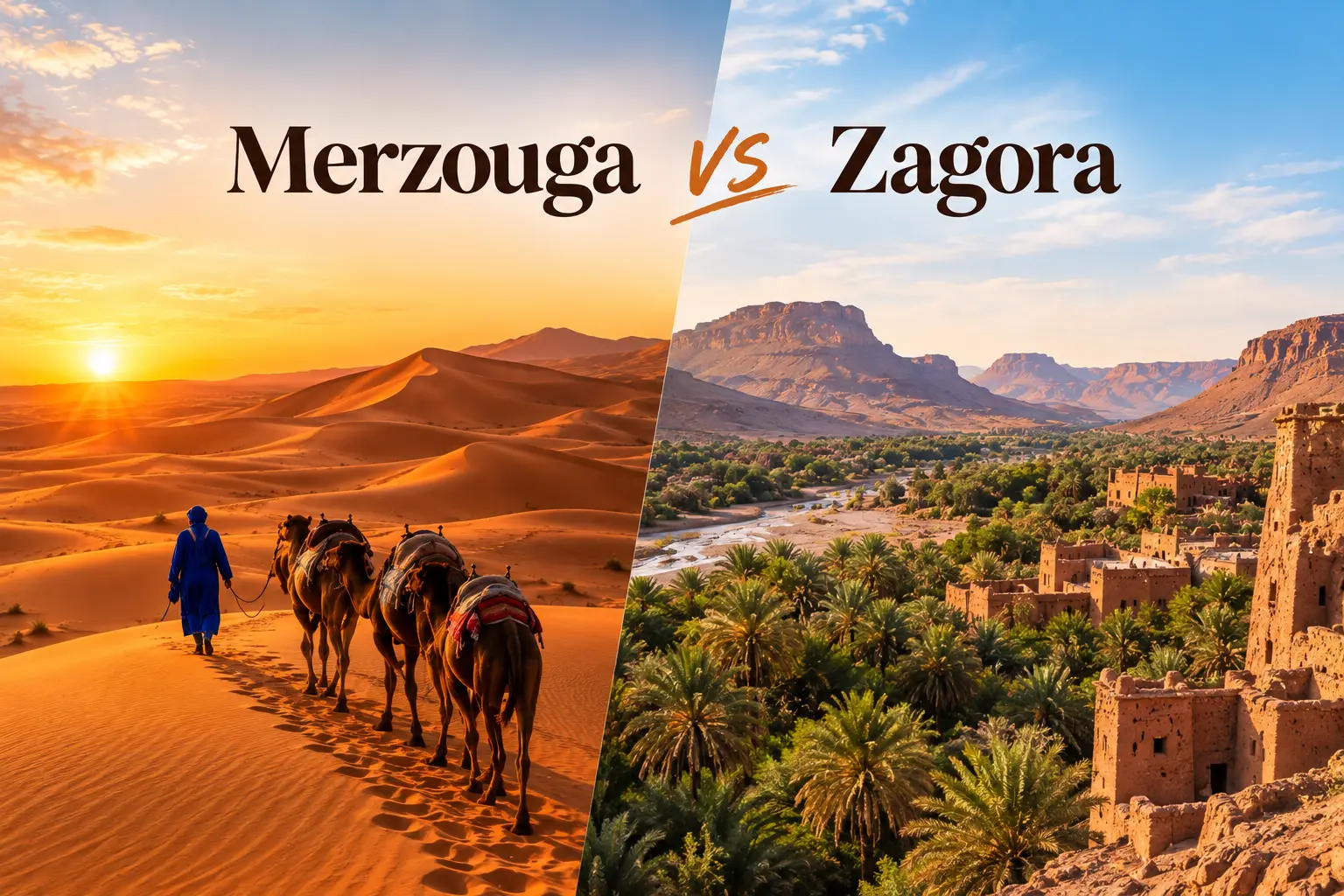
Merzouga lies much further to the east, tucked away in the Tafilalet region close to the town of Erfoud. It is positioned at the very edge of the true Saharan sand sea. While Zagora is an oasis gateway to a rocky desert plain, Merzouga sits directly at the foot of Erg Chebbi, a massive, self-contained field of wind-blown sand dunes that rises spectacularly out of the flat black stone desert (hamada).
2. The Great Landscape Debate: Golden Sand Dunes vs. Flat Stone Plains
The single most common misconception among first-time visitors to Morocco is that all deserts are filled with towering waves of soft sand. In reality, a large percentage of the Sahara consists of hamada—barren, windswept stone plains. This structural difference is the most important contrast between Merzouga and Zagora.
The Visual Majesty of Merzouga (Erg Chebbi)
If your dream is to climb massive, rolling hills of soft, orange-gold sand that change color from pink to gold depending on the sun, Merzouga is exactly what you are looking for.
The dunes of Erg Chebbi stretch across an area roughly 28 kilometers long and up to 7 kilometers wide. Some of these linear dunes rise to astonishing heights of over 150 meters. The sand is incredibly fine, clean, and beautifully sculpted by the wind. Standing on a high crest in Merzouga gives you a true 360-degree view of endless sand waves, completely matching the classic cinematic image of the Sahara seen in films.
The Authentic Simplicity of Zagora (Tinfou and Flat Erg)
Zagora offers a much more rugged, rocky, and mountain-framed landscape. The area immediately surrounding Zagora does not feature massive sand formations. Instead, it is a flat, earthy desert plain covered in dark stones, low shrubs, and small, isolated sand pockets.
There are dunes nearby, such as those at Tinfou, but they are relatively small, low, and mixed with darker soil and rocks. Zagora provides a wonderful sense of isolation, vast open spaces, and spectacular mountain backdrops, but it will not give you the visual illusion of being lost in a boundless sea of towering sand dunes.
3. Travel Distance and Timeframes: The Logistics of Getting There
Because Morocco’s infrastructure must navigate the winding passes of the Atlas Mountains, travel times are long. Your available time in Morocco will likely be the primary deciding factor between these two destinations.
| Metric / Feature | Zagora Desert | Merzouga Desert |
| Distance from Marrakech | Approx. 355 km (220 miles) | Approx. 560 km (350 miles) |
| Direct Driving Time | 7 to 8 hours | 9 to 10 hours |
| Recommended Tour Duration | 2 Days / 1 Night | 3 Days / 2 Nights (or 4 Days) |
| Road Conditions | Winding mountain passes, then smooth valley roads | Winding mountain passes, long canyon drives, deep south plains |
| Pace of Travel | Fast, packed, efficient | Balanced, immersive, with scenic overnight stops |
Why Zagora is the King of Short Trips
Getting from Marrakech to Zagora requires driving across the High Atlas Mountains via the Tizi n’Tichka Pass, descending into Ouarzazate, and tracing the Draa Valley south.
Because it takes roughly 7.5 hours of driving, it is entirely possible to complete this journey as a 2-day, 1-night excursion. You leave Marrakech early on Day 1, enjoy a sunset camel trek, sleep in a desert camp, and drive back on Day 2. It is fast-paced and involves a lot of time in the vehicle, but it fits perfectly into tight travel schedules.
Why Merzouga Demands a Minimum of Three Days
Merzouga is located deep in the southeastern corner of the country. A direct drive from Marrakech takes at least 9 to 10 hours of pure road time, without accounting for stops, meals, or traffic.
Attempting to visit Merzouga on a 2-day trip is physically exhausting and highly discouraged. To truly enjoy Merzouga, a 3-day, 2-night itinerary is the absolute minimum requirement. This layout breaks up the long drive by stopping overnight in the stunning Dades Valley or Boumalne Dades on the first night, allowing you to arrive at the big dunes on Day 2 feeling refreshed and ready to explore.
4. Itinerary Deep-Dives: What Do You See Along the Way?
The journey to the desert is just as important as the destination itself. Both routes showcase incredible UNESCO World Heritage sites, deep river canyons, and ancient architecture, but they diverge completely after passing the gateway city of Ouarzazate.
The 2-Day Zagora Route: Focused and Cultural
On a standard short-duration trek to Zagora, your route is designed for maximum efficiency, grouping together some of Morocco’s most famous cultural highlights:
- The Tizi n’Tichka Pass: A breathtaking mountain highway rising 2,260 meters above sea level, offering panoramic views of traditional, terraced Berber villages clinging to cliff sides.
- Ait Benhaddou Kasbah: This spectacular, UNESCO-protected earthen fortress village is a masterpiece of southern Moroccan architecture. It has served as the backdrop for iconic Hollywood films and series, including Gladiator, Kingdom of Heaven, and Game of Thrones.
- Ouarzazate: Known as the “Hollywood of Africa,” here you can see the historic Taourirt Kasbah and explore the massive Atlas Film Studios
- The Draa Valley Oasis: A stunning landscape where a ribbon of millions of date palms stretches across the dry terrain, punctuated by ancient, fortified mud-brick villages (Ksour).
To experience this incredible, efficient route firsthand, you can explore the fully organized 2-Day Desert Tour from Marrakech to Zagora
The 3-Day Merzouga Route: The Ultimate Deep-South Overland Expedition
Because the physical overland journey to Merzouga is significantly longer, it unlocks a much deeper, highly varied, and unhurried exploration of Morocco’s most celebrated natural wonders. It beautifully encompasses all the scenic highlights of the High Atlas Mountains and Ouarzazate, before branching off onto the spectacular “Road of 1,000 Kasbahs” to reveal:
- The Dades Valley and Dades Gorges: Globally famous for its jaw-dropping, wildly winding cliffside roads, dramatic canyon vistas, and unique, highly unusual eroded rock formations affectionately referred to by geologists and locals as the “monkey fingers.”
- The Valley of the Roses (Kelaat M’gouna): The undisputed agricultural center of Moroccan rose-water, absolute oil, and organic cosmetic production. The entire valley fills the air with an intoxicating, sweet fragrance during the vibrant spring harvest season.
- The Todra Gorges: A majestic, incredibly narrow limestone canyon where sheer, smooth rock walls tower a massive 300 meters directly over a crystal-clear, slow-flowing mountain river. It is an absolute paradise for nature walkers, landscape photographers, and international rock climbers.
- Erfoud and Rissani: The absolute final staging towns before entering the deep sand dunes. Erfoud is internationally famous for its rich deposits of prehistoric marine fossils and artisan marble workshops, while Rissani offers an incredibly raw, bustling, and authentic traditional desert souk that has operated for centuries.
If you are ready for the ultimate Saharan adventure across towering dunes and deep canyons, explore our signature 3-day desert tour from Marrakech to Merzouga.
5. Camping and Overnight Experiences: Sahara Nights Under the Stars
Sleeping deeply in an authentic desert camp under a brilliant, unpolluted night sky is undeniably the emotional core and spiritual highlight of any Morocco tour. While both destinations feature traditional camel rides, glowing campfires, and rhythmic music, the physical layout, structural isolation, and overall aesthetic vibe of the base camps differ dramatically due to the surrounding wilderness terrain.
The Wilderness Camping Experience in Zagora
The desert camps in Zagora are typically situated on flat, hard-packed earth floors bordered gracefully by smaller, rolling sand hills and dramatic, distant mountain ridges. Because the local terrain is flat and easily accessible by standard vehicles, these camps are highly functional, compact, and located relatively close to local regional infrastructure.
The baseline experience remains wonderfully traditional and deeply heartwarming: you arrive at the camp via an easy, highly enjoyable 1-hour sunset camel ride across the flats. Once inside the camp, you are served a massive, piping hot traditional Moroccan dinner of slow-cooked tagine and fresh bread inside a cozy, nomad-style wool tent. The evening is spent gathering around a large, cracking central campfire, listening to your local Berber hosts perform soulful drumming and ancient desert songs. Because the camp sits closer to towns, you do not experience a feeling of absolute, terrifyingly remote isolation, but the pure warmth of the indigenous hospitality is truly unforgettable.
The Wilderness Camping Experience in Merzouga
Merzouga elevates the overnight desert camping experience to a world-class, deeply cinematic luxury level. The camps here are completely hidden within the deep valleys of the massive Erg Chebbi sand waves, entirely shielding them from the outside world. When you sit in the center of a camp in Merzouga, absolutely nothing else is visible in any direction except pristine, towering walls of pure sand.
Over the last decade, Merzouga has evolved into a premier global hub for ultra-premium luxury desert glamping. The high-end tents here routinely feature massive king-sized beds, rich hand-woven Moroccan carpets, private ensuite bathrooms, fully functioning flushing toilets, and running hot showers with excellent water pressure.
The trek to reach these hidden camps involves a deep, deeply meditative 1.5 to 2-hour camel journey across massive, undulating sand waves, making your final arrival feel like an incredible geographical discovery. Due to the complete absence of light pollution deep within the grand sand sea, stargazing in Merzouga is an otherworldly experience, revealing the full, glowing band of the Milky Way with absolute clarity.
6. Activities, Sports, and Excursions: Beyond the Camel Ride
If you are a high-energy traveler looking for an active, adrenaline-fueled holiday packed with outdoor adventure sports, deep cultural explorations, and off-road thrills, your choice will automatically lean heavily toward one specific desert destination.
High-Octane Adventure Options in Merzouga
Because the massive dune field of Erg Chebbi is a massive, shifting sandbox, it serves as the ultimate natural playground for outdoor adrenaline sports and high-energy desert adventures:
- 4×4 Off-Road Dune Bashing: Speeding up, over, and down the near-vertical crests of the massive Erg Chebbi dunes in a professionally modified, high-clearance four-wheel-drive vehicle is an absolutely thrilling, unforgettable adrenaline rush.
- Quad Biking and Dune Buggy Tours: Renting a powerful ATV quad bike or a specialized open-air dune buggy allows adventure seekers to pilot their own high-speed vehicles across designated, thrilling sections of the sand dunes.
- Sandboarding: Strapping into a customized snowboard and carving down the steep, pristine 100-meter face of a pure Saharan sand dune is a unique thrill that can only be properly experienced on the massive dune structures of Merzouga.
- Nomadic and Tribal Cultural Immersions: The rugged desert terrain surrounding Erg Chebbi is still actively home to traditional, resilient nomadic families. Many curated tours stop to visit their temporary encampments to learn about their unique way of life and share fresh mint tea. Furthermore, travelers can visit the historic village of Khamlia to sit with the local community and listen to the hauntingly beautiful, soulful rhythms of traditional Gnawa music, historically played by the descendants of sub-Saharan Africans.
Cultural and Trekking Options in Zagora
Zagora’s unique combination of flat, rocky stone plains, ancient oasis riverbeds, and dense historical settlements lends itself beautifully to a completely different style of desert discovery, focused heavily on heritage, walking, and rural village life:
- Long-Distance Desert Trekking: The flat, firm, highly stable stone ground (hamada) is absolutely ideal for multi-day walking tours, wilderness hiking, and minimalist desert backpacking without the exhausting, physically draining challenge of climbing shifting sand.
- Deep Historical Exploration: Zagora sits in close proximity to the fascinating historical town of Tamegroute. This ancient spiritual center is world-famous for its incredible, sprawling underground kasbah, its highly distinct green manganese pottery workshops that still utilize ancient firing techniques, and a magnificent 17th-century Quranic Library that carefully houses priceless, ancient scientific and religious manuscripts meticulously written on fine gazelle hide.
- Traditional Oasis Walks: Wandering peacefully through the cool, refreshing shade of the Draa Valley’s dense date palm groves offers travelers an intimate, fascinating look at traditional, highly complex multi-tiered oasis agricultural and irrigation systems that have sustained human life in the desert for thousands of years.
7. Cost Analysis, Crowds, and Comfort: Weighing the Travel Trade-offs
Making your final booking decision requires a balanced, realistic analysis of your personal holiday budget, your individual tolerance for crowds, and your desired baseline level of physical comfort.
The Budget Analysis
- Zagora is almost universally the significantly more economical, budget-friendly choice. Because the entire tour duration is shorter (2 days instead of 3 or 4), travelers save a massive amount on vehicle fuel, private driver fees, and tour operational costs, while only needing to pay for a single night of commercial accommodation. General food prices, souvenirs, and local guide fees along this transit corridor are also naturally lower due to its high efficiency.
- Merzouga undeniably carries a much higher baseline price tag. The significantly extended driving mileage requires higher fuel consumption, multiple days of private driver compensation, and the mandatory inclusion of an extra night of lodging along the route. Furthermore, the highly exclusive, isolated nature of the premium luxury camps hidden deep within the high dunes naturally commands a higher rate. However, an overwhelming majority of international travelers consider it a far higher-value experience because of the absolute visual magnificence of the landscapes.
Crowds and Commercial Dynamics
- Because Zagora is highly accessible, close to Marrakech, and budget-friendly, it naturally attracts a steady, continuous stream of weekend travelers, large group bus tours, and time-restricted excursions. During the peak tourism seasons (spring and autumn), the main camel tracks and the small localized dune pockets can feel somewhat busy and lively.
- Merzouga also draws a very large number of international tourists every year. However, because the actual Erg Chebbi dune field is physically vast and expansive, the various desert camps are spread incredibly far apart, hidden from one another by massive ridges of sand. It is incredibly easy to simply walk over a single sand crest from your tent and instantly find absolute, profound, silent solitude where you cannot see, hear, or feel the presence of any other human being on Earth.
8. The Ultimate Summary Matrix: Which Desert Wins Your Choice?
To make your final decision as seamless and stress-free as possible, review this quick-reference analytical checklist to see which Moroccan desert destination perfectly aligns with your current travel profile.
You Should Confidently Choose Zagora If:
- Your available holiday time is strictly limited: You only have exactly 48 hours to spare in your broader itinerary and cannot afford to dedicate 3 or 4 full days away from exploring Marrakech or Fes.
- You are traveling on a strict financial budget: You want to experience the authentic magic of a camel ride, a traditional campfire, and a night sleeping under the stars without spending a large portion of your travel funds.
- You want to minimize long hours in a vehicle: You prefer a shorter, less physically demanding driving experience that gets you to the desert environment quickly.
- Your primary interests are history and oases: You are deeply fascinated by ancient mud fortresses like Ait Benhaddou, historic libraries, and walking through lush, palm-filled river valleys.
You Should Confidently Choose Merzouga If:
- You demand classic, towering sand dunes: You will feel genuinely disappointed if you leave Morocco without standing in an endless, pristine sea of colossal, rolling, fine golden sand waves.
- You have at least 3 or 4 full days available: You have the flexibility to travel at an immersive, relaxed pace and want to enjoy a properly spaced, rewarding overland journey.
- You want a world-class luxury glamping experience: You love the romantic concept of sleeping in a premium, high-end tent equipped with private hot showers, fine linens, and gourmet dining hidden deep in a remote sand valley.
- You are eager for high-energy outdoor sports: You are highly excited by the prospect of sandboarding, professional 4×4 off-road dune driving, and piloting quad buggies across open sand dunes.
Securing Your Dream Sahara Experience
In the final analysis, neither desert destination is universally “better” than the other; rather, they are designed to fulfill completely different travel parameters, timeframes, and personal desires. Zagora serves as an incredibly efficient, culturally rich, and highly practical shortcut that provides an authentic taste of pre-Saharan life when your calendar is tight. Merzouga is the grand, cinematic, deeply immersive destination that rewards a longer journey with some of the most jaw-droppingly spectacular natural desert landscapes on the face of the planet.
Whichever path you ultimately choose, crossing the sweeping peaks of the Atlas Mountains and watching the golden sun drop below the southern Moroccan horizon is a deeply transformative, unforgettable travel experience. Align your choice carefully with your personal timeline, select the ideal itinerary for your group, and get ready to experience the timeless, breathtaking magic of the majestic Moroccan Sahara.